When you notice your hands becoming clumsy with everyday tasks like buttoning a shirt, or your legs feeling heavy and unsteady when you walk, these subtle changes might be warning signs of something more serious than ordinary neck or back pain. Myelopathy is a condition caused by compression (pressure) on your spinal cord, and unlike typical aches and pains that come and go, it represents a genuine threat to your nervous system that demands prompt attention. While common back or neck pain usually stems from irritated muscles, joints, or nerve roots, myelopathy affects the spinal cord itself—the critical highway of nerve signals between your brain and the rest of your body. When left untreated, this compression can lead to permanent nerve damage and irreversible loss of function, making early diagnosis and treatment essential to protecting your long-term health and independence.
Dr. John Peloza specializes in diagnosing the underlying causes of myelopathy and providing advanced treatment solutions designed to relieve spinal cord compression before permanent damage occurs. With extensive expertise in both complex spine surgery and motion-preserving techniques, Dr. Peloza takes a comprehensive approach to each patient’s condition, using state-of-the-art diagnostic imaging to pinpoint the exact source of compression and creating personalized treatment plans that address your specific needs. Whether your symptoms are just beginning to emerge or have been gradually worsening over time, getting an accurate diagnosis and exploring your treatment options now can make the difference between halting the condition’s progression and facing permanent neurological complications
ADVANCED TECHNOLOGY MEETS SURGICAL EXPERTISE
Recognizing Early Symptoms of Myelopathic Pain
When you notice your hands becoming clumsy with everyday tasks like buttoning a shirt, or your legs feeling heavy and unsteady when you walk, these subtle changes might be warning signs of something more serious than ordinary neck or back pain. Myelopathy is a condition caused by compression (pressure) on your spinal cord, and unlike typical aches and pains that come and go, it represents a genuine threat to your nervous system that demands prompt attention. While common back or neck pain usually stems from irritated muscles, joints, or nerve roots, myelopathy affects the spinal cord itself—the critical highway of nerve signals between your brain and the rest of your body. When left untreated, this compression can lead to permanent nerve damage and irreversible loss of function, making early diagnosis and treatment essential to protecting your long-term health and independence.
Dr. John Peloza specializes in diagnosing the underlying causes of myelopathy and providing advanced treatment solutions designed to relieve spinal cord compression before permanent damage occurs. With extensive expertise in both complex spine surgery and motion-preserving techniques, Dr. Peloza takes a comprehensive approach to each patient’s condition, using state-of-the-art diagnostic imaging to pinpoint the exact source of compression and creating personalized treatment plans that address your specific needs. Whether your symptoms are just beginning to emerge or have been gradually worsening over time, getting an accurate diagnosis and exploring your treatment options now can make the difference between halting the condition’s progression and facing permanent neurological complications
Myelopathy is a neurological condition (affecting your nervous system) that develops when something compresses or squeezes your spinal cord severely enough to interfere with how it functions. Your spinal cord is essentially a bundle of nerves that acts as the main communication highway between your brain and the rest of your body, carrying signals that control movement, sensation, and coordination. When pressure builds up on this delicate structure—whether from a herniated disc, bone spurs (bony growths), thickened ligaments, or narrowing of the spinal canal (stenosis)—the spinal cord cannot send and receive messages properly, leading to a cascade of symptoms that can affect your hands, arms, legs, and even bladder or bowel function.
While you might expect a condition called “myelopathic pain” to primarily involve severe pain, the reality is quite different and often confusing for patients. Pain is actually a secondary symptom in myelopathy, if it occurs at all. The hallmark features of this condition are neurological problems like numbness, tingling, weakness in your hands and legs, loss of fine motor skills (such as difficulty buttoning clothes or writing), and coordination problems that make walking feel unsteady or clumsy. This is fundamentally different from conditions like a pinched nerve (radiculopathy), where pain is the dominant symptom caused by irritation of a single nerve root exiting the spine. With myelopathy, you’re dealing with dysfunction of the spinal cord itself—a much more serious situation that affects multiple nerve pathways at once and can lead to permanent disability if not addressed promptly.
REDEFINING WHAT RECOVERY CAN LOOK LIKE
Common Causes of Myelopathic Pain
A long list of conditions, diseases, and traumas can cause myelopathic pain, but the most common causes are:
Cervical spondylotic myelopathy: Age-related changes in your neck such as bulging discs, bone spurs (bony growths), or thickened ligaments that squeeze the spinal cord.
Thoracic spondylotic myelopathy: Similar age-related changes that squeeze the spinal cord in your mid-back, though this is less common than in the neck.
Spinal canal stenosis: A narrowing of the space where your spinal cord sits, either present from birth or developing over time, usually with aging.
Trauma (injury): Sudden spinal cord injury from an accident or long-term changes after an injury that compress the spinal cord.
Metastatic cancer: Cancer that has spread from another part of your body to the spine or the space around the spinal cord, causing compression.
Ossification of the posterior longitudinal ligament or OPLL: A condition where a ligament in your spine gradually turns to bone, squeezing the spinal cord in your neck. Most common in East Asian populations.
Congenital anomalies (birth defects): Structural problems with the spinal cord or spine that were present from birth, such as a spinal cord that is abnormally attached or split.
Inflammatory or demyelinating disorders: Diseases like multiple sclerosis where your immune system attacks the protective coating around nerves in the spinal cord.
Recognizing the Symptoms of Myelopathy
One of the most challenging aspects of myelopathy is that it rarely announces itself with dramatic symptoms—instead, it typically creeps into your life so gradually that you might dismiss the early warning signs as normal aging or simply “slowing down”. You might first notice subtle changes like difficulty buttoning your shirt, dropping your keys more often, or feeling slightly unsteady on your feet, but these symptoms can be so mild and develop so slowly over months or even years that many people don’t connect them to a serious underlying problem. This insidious onset (gradual beginning) makes myelopathy particularly easy to overlook, especially since it commonly affects people in their 50s and 60s when they might attribute coordination problems or weakness to getting older. However, unlike the normal changes that come with age, myelopathy symptoms are persistent and progressive—they don’t come and go, and they gradually worsen over time if left untreated. Recognizing that these seemingly minor changes could signal spinal cord compression is crucial, because early diagnosis and treatment can prevent the condition from progressing to permanent nerve damage and disability.
Key Symptoms of Myelopathy:
Numbness, tingling, or weakness in the arms, hands, legs, or feet: This happens because the compressed spinal cord cannot properly send sensation signals up to your brain or movement signals down to your muscles.
Difficulty with fine motor skills: Tasks like buttoning a shirt, writing, picking up coins, fastening jewelry, or using utensils become challenging because the spinal cord compression interferes with the precise control signals your brain sends to your hands.
Balance and coordination issues: You may feel unsteady when walking, have trouble with your gait, or find it difficult to know where your feet are without looking down, because the spinal cord damage disrupts your body’s ability to sense its position in space.
Heaviness or clumsiness in the limbs: Your arms or legs may feel heavy, stiff, or awkward, making movements feel unnatural or requiring more effort than usual.
Loss of bladder or bowel control: In advanced or severe cases, you may experience urgent needs to urinate, accidental leakage, difficulty fully emptying your bladder, or similar bowel problems, because the compressed spinal cord affects the nerve signals that control these functions.
The Diagnostic Process: How Myelopathy is Confirmed
Diagnosing myelopathy requires a careful combination of hands-on physical examination and advanced imaging technology to obtain a complete picture of what’s happening in your spine. Your evaluation begins with a thorough neurological assessment where Dr. Peloza checks your reflexes (automatic responses when certain areas are tapped), muscle strength throughout your arms and legs, sensation in various areas of your body, coordination, and walking pattern. These physical findings help pinpoint which areas of your spinal cord may be affected and how severely. However, the physical examination alone cannot definitively confirm myelopathy or identify its underlying cause; advanced imaging is essential.
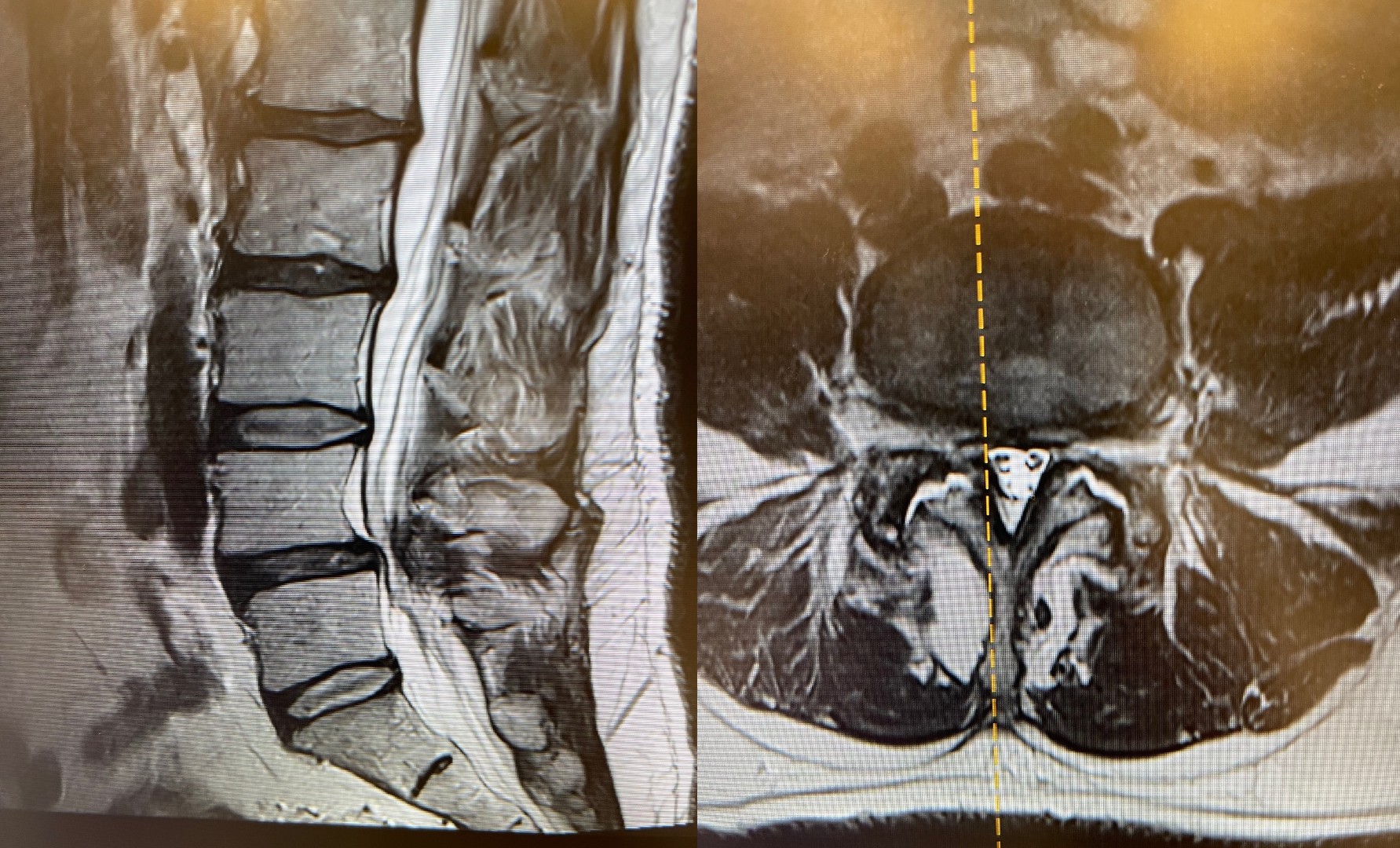
Magnetic resonance imaging (MRI) is considered the gold standard test because it provides detailed images of your spinal cord, showing exactly where and how severely the cord is being compressed, and can reveal the specific structures causing the problem, whether it’s a herniated disc, bone spurs, thickened ligaments, or other issues. In some cases, computed tomography (CT) scans may also be used, particularly to get better views of the bony structures of your spine. By carefully correlating what is found during your physical examination with what the imaging reveals, Dr. Peloza can accurately confirm the diagnosis and develop a treatment plan specifically tailored to address the cause of your spinal cord compression.
Treatment Options for Myelopathic Pain and Dysfunction
Conservative (Non-Surgical) Management:
When first diagnosed with myelopathy, many patients hope that non-surgical approaches like physical therapy, medications, or wearing a cervical collar (neck brace) might resolve their symptoms. While these conservative treatments can help manage pain and may stabilize your condition temporarily, they cannot remove the physical pressure on your spinal cord. Conservative management including physical therapy, anti-inflammatory medications, activity modifications, and sometimes cervical immobilization can provide symptom relief for patients with very mild myelopathy or those who cannot have surgery due to other health concerns. However, because myelopathy is caused by mechanical compression that typically worsens over time, conservative treatments alone rarely halt the its progression. For patients with moderate to severe symptoms or progressive neurological deterioration, surgical decompression remains the gold standard treatment.
Surgical Interventions to Decompress the Spinal Cord:
Dr. Peloza offers several advanced surgical techniques; each tailored to the specific location and cause of your myelopathy.
Spinal Decompression: This is the general term for a category of surgical procedures all designed to relieve pressure on your spinal cord and nerve roots. Depending on what’s causing your myelopathy, e.g., herniated discs, bone spurs, or thickened ligaments, Dr. Peloza may use various decompression techniques to remove or modify the structures that are squeezing your spinal cord.
Laminectomy: This procedure involves removing a portion of the vertebra called the lamina (the bony roof that covers the back of your spinal canal) to create more space for the compressed spinal cord. By removing this bone, the spinal cord has room to shift backward away from the pressure, providing immediate relief from compression. Laminectomy is often recommended when you have a narrow spinal canal, compression affecting multiple levels of your spine, or enlarged ligaments pressing on the cord from behind.
Anterior Cervical Discectomy and Fusion (ACDF): This procedure involves approaching your spine from the front of your neck to remove a damaged or herniated disc that’s compressing your spinal cord. After removing the problematic disc, Dr. Peloza fills the empty space with a bone graft (either your own bone or a bone substitute) and often secures it with a small metal plate and screws to hold the vertebrae in place while they heal together into a solid bone. This approach directly accesses the source of compression from the front of your spinal cord, making it particularly effective when the pressure is caused by disc problems at one or more levels. The fusion process typically takes several months as the bone graft incorporates and the vertebrae permanently join together. While fusion does eliminate motion at the treated segment, it provides stability and prevents painful movement that could further compress your spinal cord.
Cervical Corpectomy and Fusion: This procedure is similar to a discectomy but more extensive. Instead of removing just the disc, Dr. Peloza removes part or all of a vertebra (the main bony blocks of your spine) along with the adjacent discs. After removing the affected vertebrae, the gap is filled with a bone graft or synthetic spacer (called a strut graft) that bridges the space between the remaining healthy vertebrae above and below, and this is stabilized with metal plates and screws. Corpectomy provides more extensive decompression for severe or multilevel spinal cord compression and allows the surgeon to address compression that extends behind the vertebral bodies. This procedure is particularly effective for patients with cervical spondylotic myelopathy who have significant bone-related compression.
Artificial Disc Replacement: For carefully selected patients, artificial disc replacement offers a motion-preserving alternative to traditional fusion surgery. This advanced procedure involves removing the damaged disc that’s compressing your spinal cord and replacing it with an artificial disc that allows your neck to maintain its natural range of motion. By preserving motion at the treated level, this approach may help prevent adjacent segment disease (wear and tear at the levels above and below the surgery) that can sometimes develop after fusion procedures. If ADR is used, it is combined with other procedures
The most important thing to understand about myelopathy is that time matters. Myelopathy is a progressive condition, which means it tends to worsen over time. Once your spinal cord sustains permanent damage, that injury cannot be reversed. Studies consistently show that patients who delay treatment and live with symptoms for longer periods before surgery tend to have less favorable outcomes and lower chances of meaningful neurological recovery compared to those who seek treatment earlier. If left untreated, myelopathy can progress to severe disability, including permanent weakness in your arms and legs, persistent balance problems that increase your fall risk, and loss of bladder or bowel control. Research indicates that symptom duration is one of the most important factors influencing your prognosis—the longer you wait, the more difficult it becomes to recover lost function.
The primary goal of surgery for myelopathy is to halt the progression of your condition and prevent further damage to your spinal cord by removing the source of compression. It is important to have realistic expectations: while surgery is highly effective at stopping the condition from getting worse, the degree of improvement varies from person to person. Studies show that approximately 50 to 80 percent of patients experience meaningful improvement after decompression surgery, with the most significant gains typically occurring within the first six months after the procedure. Factors that predict better surgical outcomes include younger age, shorter duration of symptoms before surgery, milder baseline disability, and single-level rather than multilevel compression. Even patients who do not experience dramatic improvement in their symptoms still benefit enormously from surgery by preventing what would otherwise be continued deterioration and increasing disability. The key message is clear: early diagnosis and timely treatment offer you the best chance of preserving your current function and potentially regaining abilities you have lost.
Why Choose Dr. Peloza for Myelopathy Treatment?
Choosing the right spine surgeon for myelopathy treatment is one of the most important decisions you’ll make, as the expertise and approach of your surgeon can significantly impact your outcome. Dr. John Peloza brings over four decades of specialized experience in complex spine surgery to every patient consultation, combining cutting-edge techniques with a deep understanding of spinal cord conditions. As a board-certified orthopedic spine surgeon, he has particular expertise in the decompression procedures essential for treating myelopathy, including laminectomy, laminoplasty, and both anterior and posterior cervical decompression techniques. Dr. Peloza is recognized nationally as one of the “50 Best Spine Specialists in America” by Becker’s Orthopedic and Spine Review and has been honored with the Becker’s Healthcare Spine Leadership Award for his contributions to advancing spine care. His pioneering work in minimally invasive spine surgery means that when surgery is necessary, he can often perform these complex decompression procedures through smaller incisions, potentially leading to faster recovery times and less post-operative discomfort.
Accurate diagnosis is the foundation of effective myelopathy treatment, and Dr. Peloza’s commitment to advanced diagnostic technology sets him apart. He has pioneered the use of intraoperative image-guided navigation surgery and is currently involved in cutting-edge artificial intelligence spinal imaging and augmented reality intraoperative navigation. These advanced tools allow him to pinpoint the exact location and cause of your spinal cord compression with exceptional precision, ensuring that treatment targets the root problem rather than just addressing symptoms. This technological expertise, combined with decades of clinical experience evaluating thousands of myelopathy cases, means you can trust that your diagnosis will be thorough, accurate, and based on the most comprehensive imaging available.
Perhaps most importantly, Dr. Peloza understands that every patient’s myelopathy is unique, requiring an individualized approach rather than a one-size-fits-all solution. His practice philosophy centers on providing “tailored options and predictable results thanks to years of valuable clinical research and data collection.” Whether your condition is best treated with conservative management, minimally invasive decompression, or more extensive surgical reconstruction, Dr. Peloza takes the time to understand your specific symptoms, lifestyle goals, and overall health status before recommending a treatment path. His extensive training and experience with the full spectrum of spine care options means he can offer you truly personalized care designed around your individual needs, not just what’s familiar or convenient for the surgeon.
Schedule a Consultation for Your Symptoms Today
Myelopathy is a progressive condition that shouldn’t be ignored—symptoms like hand clumsiness, balance problems, numbness, or weakness are warning signs that demand prompt medical attention. Delaying treatment increases your risk of permanent nerve damage and irreversible functional loss, while early diagnosis offers the best chance for preserving your current abilities and potentially recovering lost function. If you’re experiencing difficulty with fine motor tasks, unexplained weakness in your arms or legs, balance issues, numbness or tingling, or changes in bladder or bowel function, don’t wait to seek expert evaluation. Dr. Peloza’s comprehensive diagnostic approach will provide you with answers and a personalized treatment plan backed by decades of expertise.
Taking the first step toward diagnosis and treatment is simple. Contact Dr. Peloza’s office in Chesterfield, Missouri to schedule your consultation:
Dr. Peloza’s experienced team is ready to help you understand your symptoms, explore your treatment options, and create a personalized care plan designed to protect your spinal cord health and help you return to the active, pain-free life you deserve. Don’t let myelopathy progress—schedule your consultation today and take control of your spine health with one of America’s leading spine specialists.
“Dr. Peloza is outstanding. His bedside manner is bar none-he's compassionate, patient, and genuinely cares about his patients. He is incredibly smart, explains things in a way that makes you feel confident and informed, and never rushes you. I wouldn't trust anyone else with my spine issues and feel very lucky to have found him.”
- Cathy C.,
“I had disabling back pain interfering with my work, my sleep, and my leisure. After consulting several excellent physicians in Dallas who all recommended complicated fusion surgery I traveled to see Dr. Peloza and had surgery without a fusion and its downrange complications. 1 month later I am pain free and once again active in all daily activities. His staff is amazing and they coordinate all aspects of your care and do a great job on Tele care as well. Dr. Peloza cares about his patient's quality of life and their perception of care. There is none better when it comes to bedside manner, patient communication, expertise in the field, and access to care. Don’t want to be another 'Postlaminectomy syndrome on chronic pain meds' - Then this is the place to trust for your care!”
- AS,
“Dr. Peloza and his staff were incredible to work with from the beginning of my diagnosis to the surgery and the aftercare. Would highly recommend him!!”
- Michael J.,
“I’m extremely pleased, I feel honored to recommend Dr. Peloza to everyone. I can actually say he saved me and changed my life. I now feel like I have a reason to get up and enjoy the beautiful day that God blessed me with.”
- Deb J.,
“I absolutely think this man is an amazing doctor! He replaced 4 discs in my C-spine and he is doing my lumbar spine very soon! I HIGHLY HIGHLY recommend him! I am so grateful for everything!”
- Cathy W.,
“Dr. Peloza is an extremely gifted surgeon and practitioner. I have recommended him to anyone who will listen to how having a disc replacement has changed my life!”
- Jacque C.,
“Dr. Peloza has been phenomenal from the first day I saw him! His extended tests helped to get a proper diagnosis, as well as he has been quick to come up with a treatment plan for me. His staff are professional, friendly, and quick to offer help. One of the best!”
- Kelly M.,
CASE HIGHLIGHTS
Discover breakthrough treatments and remarkable patient recoveries.